

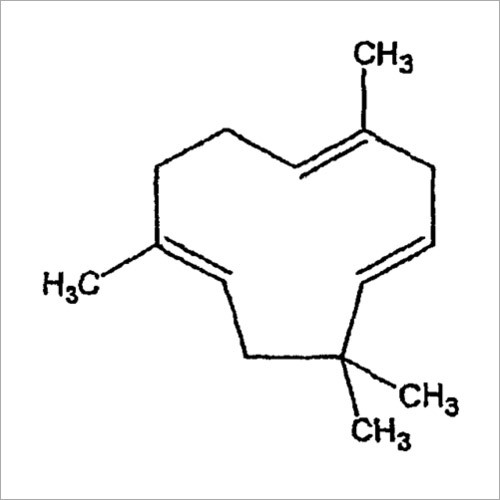
Caryophyllene Acetate
1100 INR
Product Details:
- Physical Form Liquid
- Structural Formula Caryophyllene acetate
- Molecular Formula C17H26O2
- Taste Mild, slightly bitter
- Assay 98%
- Heavy Metal (%) <0.001%
- Appearance Liquid
- Click to View more
X
Caryophyllene Acetate Price And Quantity
- 25 Kilograms
- 1100 INR
Caryophyllene Acetate Product Specifications
- Bicyclogermacrene acetate, beta-Caryophyllene acetate
- 24 months
- <0.001%
- Characteristic, woody odour
- 77-54-3
- 98%
- 279-280C
- Terpene Ester
- Mild, slightly bitter
- Not applicable (liquid at room temperature)
- 2255
- C17H26O2
- 98%
- Flavor and fragrance, aromatherapy, pharmaceuticals
- Caryophyllene acetate
- Insoluble
- Cool, dry, well-ventilated area
- 9.4 (air=1)
- Liquid
- Liquid
- Soluble in ethanol, oils
- Colorless to pale yellow
- Not regulated
- Sesquiterpene ester
- 0.963 g/cm3
- Caryophyllene acetate
- >93C
- 1.499-1.505 (20C)
- <2% total impurities
- Sealed containers, amber glass or HDPE bottles
- Food Grade/USP Grade
- Biodegradable
- +7 to +20
- Stable under recommended storage conditions
Caryophyllene Acetate Trade Information
- Cash in Advance (CID), Cash Advance (CA)
- 10 Kilograms Per Week
- 1 Days
- All India
Product Description
Properties
- Chemical formula : C15H24
- Molar mass : 204.36 gmol1
- Density : 0.9052 g/cm3 (17 C)[1]
- Boiling point : 254257 C (489495 F; 527530 K)[2]
Technical specification:
| Packaging Type | Bottle |
| Physical State | Liquid |
| Usage | Laboratory,Domestic |
| Packaging Size | VAries from 20ml-1lt packaging |
High Purity and Quality Standards
Caryophyllene acetate meets stringent purity standards, with total impurities below 2% and heavy metals present at less than 0.001%. It complies with Food Grade and USP Grade requirements, ensuring safety for use in sensitive applications such as pharmaceutical formulations and premium food products.
Versatile Applications
Thanks to its woody aroma and mild bitterness, Caryophyllene acetate finds use in flavor and fragrance creation, aromatherapy blends, and pharmaceuticals. Its solubility in oils and ethanol expands formulation possibilities, while its stability and non-hazardous nature support reliable manufacturing and export processes.
FAQs of Caryophyllene Acetate:
Q: How should Caryophyllene acetate be stored for maximum shelf life?
A: Caryophyllene acetate should be stored in sealed containers made of amber glass or HDPE bottles in a cool, dry, and well-ventilated area. Proper storage maintains stability and extends shelf life to 24 months.Q: What are the primary applications of Caryophyllene acetate?
A: It is commonly used as an ingredient in the flavor and fragrance industries, aromatherapy, and pharmaceutical preparations due to its distinct woody odor and mild taste.Q: When can Caryophyllene acetate be used in food and pharmaceutical products?
A: Caryophyllene acetate can be used anytime in product formulations, provided compliance with the approved Food Grade and USP Grade standards is maintained.Q: Where is Caryophyllene acetate typically manufactured and exported from?
A: This ingredient is often manufactured and exported by dedicated producers in India, serving both domestic and international markets in food, fragrance, and pharmaceutical industries.Q: What makes Caryophyllene acetate a safe and environmentally friendly choice?
A: It is not classified as hazardous, is biodegradable, and contains very low levels of impurities and heavy metals, making it a sustainable option in modern formulations.Q: How is Caryophyllene acetate beneficial in aromatherapy?
A: Its characteristic woody aroma and mild bitterness contribute to soothing blends, providing a natural scent and supporting relaxation in aromatherapy applications.Tell us about your requirement

Price:
Quantity
Select Unit
- 50
- 100
- 200
- 250
- 500
- 1000+
Additional detail
Mobile number
Email

Other Products in 'Aroma Chemicals' category


We accept only bulk quantity orders & mainly deals in Europe, USA, Japan, Indonesia.
Contact Us

- 485- A/12-A, Dilshad Garden, Indl Area, G.T. Road, Delhi - 110095, India
- Phone : 08045802014
GST : 07AAACN3669B1ZO

- Mr Pradeep Khandelwal (Managing Director)
- Mobile : 08045802014
- Send Inquiry
 Send Inquiry
|


Our Products
 Send Inquiry
 Send SMS
 Call Me Free
NATURAL AROMA PRODUCTS PVT. LTD.
All Rights Reserved.(Terms of Use)
Developed and Managed by Infocom Network Private Limited.
Developed and Managed by Infocom Network Private Limited.


 English
 Spanish
 French
 German
 Italian
 Chinese (Simplified)
 Japanese
 Korean
 Arabic
 Portuguese