

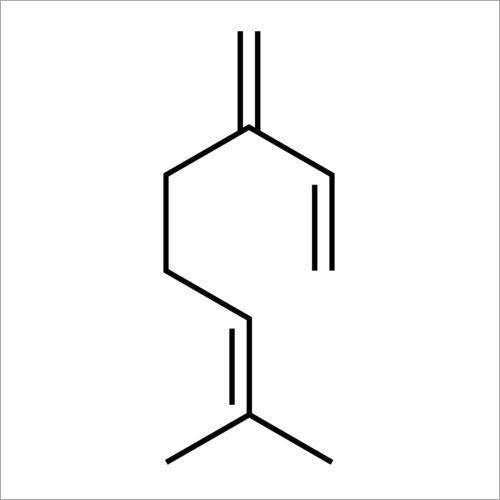
Myrcene
Product Details:
- Solubility Insoluble in Water; Soluble in Organic Solvents
- EINECS No 204-622-5
- Smell Clove-like, Spicy, Herbal
- Boiling point 167-168 °C
- Poisonous Non-poisonous
- Structural Formula CH2=C(CH3)CH2CH2C(CH3)=CHCH2CH3
- Molecular Weight 136.24 g/mol
- Click to View more
X
Myrcene Price And Quantity
- 25 , , Kilograms
Myrcene Product Specifications
- Mildly Sweet, Herbal
- Store in a cool, dry, well-ventilated area
- Neutral
- Natural Terpene Hydrocarbon
- 136.24 g/mol
- Liquid
- Flavor and Fragrance Ingredient, Intermediate in Pharmaceuticals
- Clove-like, Spicy, Herbal
- >90%
- Non-poisonous
- 167-168 °C
- CH2=C(CH3)CH2CH2C(CH3)=CHCH2CH3
- Myrcene
- Insoluble in Water; Soluble in Organic Solvents
- 204-622-5
- 123-35-3
- -66 °C
- <0.5%
- <0.001%
- 29012990
- Industrial Grade
- Clear Liquid
- 7-Methyl-3-methylene-1,6-octadiene
- Not Applicable (Liquid)
- 24 months
- C10H16
- Colorless to Pale Yellow
- 0.790-0.793 g/cm3 (20 C)
- 2.8 mmHg (25 C)
- UN 2319, Class 3, Packing Group III
- 1.471-1.474 (20 C)
- 237 C
- Stable under Normal Conditions
- Keep away from heat/sparks/open flames
- Flammable Liquid
- 44 C (Closed Cup)
Myrcene Trade Information
- as per order Per Month
- 72 Hours
Product Description
Specifications:
| Item | MYRCENE |
| Chemical Name | 7-Methly-3Nethlene-1, 6-Odtadiene |
| CAS No. | 123-35-3 |
| EINECS No. | 204-622-5 |
| FEMA No. | 2762 |
| Formula | C10H16 |
| Molecular Wt. | 136.24 |
| Color/Appearance | Colorless to slight yellow clear liquid |
| Odour | Anise, fresh, balsamic, sweet, thereal |
| Flash point | 44.40C |
| Boiling Point | 167oC |
| Content | .75%-80% |
| Relative density (at 200C) | 0.7920 to 0.8050 |
| Refractive Index (at 200C) | 1.4680 to 1.4740 |
| Optical Rotation (at 200C) | -50 to 00 |
| Solubility | Insoluble in water, soluble in ethanol. |
Key Features of Myrcene
Myrcene presents as a colorless to pale yellow liquid with purity exceeding 90%, and a characteristic herbal aroma. Its boiling point is 167-168C, while it remains stable under standard storage conditions. The compound is non-poisonous and exhibits minimal loss on drying (<0.5%) with heavy metal content under 0.001%. Myrcene is insoluble in water but is readily soluble in organic solvents, making it suitable for diverse industrial uses.
Uses in Flavor, Fragrance, and Pharmaceuticals
Myrcene is predominately employed as a key ingredient in the flavor and fragrance industries due to its distinctive scent profile. Additionally, as an intermediate in pharmaceutical synthesis, it serves as a fundamental building block in the formulation of active compounds, enhancing product quality and consistency.
Safety, Storage, and Handling Procedures
Due to its flammable nature (flash point: 44C), Myrcene should be kept away from heat sources, sparks, and open flames. Storage in a cool, dry, and well-ventilated environment is essential. Standard chemical handling protocols must be followed, including appropriate labeling and adherence to its transport classification (UN 2319, Class 3, Packing Group III).
FAQs of Myrcene:
Q: How should Myrcene be stored to ensure safety and stability?
A: Myrcene should be stored in a cool, dry, and well-ventilated area away from sources of heat, sparks, and open flames to maintain its stability and reduce fire risk. Properly sealed containers and adherence to industrial safety protocols are recommended.Q: What are the main uses of Myrcene in industry?
A: Myrcene is primarily used as a flavor and fragrance ingredient, contributing a clove-like, herbal aroma. It is also utilized as an intermediate in the synthesis of pharmaceuticals, playing a vital role in the production of various active pharmaceutical ingredients.Q: When handling Myrcene, what precautions should be taken?
A: During handling, precautions include keeping Myrcene away from heat, sparks, and open flames due to its flammable nature. Personal protective equipment should be worn, and chemical handling guidelines must be strictly followed to minimize risk.Q: Where is Myrcene typically manufactured and exported from?
A: Owing to its widespread application, Myrcene is manufactured and exported by several producers, with India being a notable exporter due to its advanced production capabilities and compliance with international safety standards.Q: What benefits does Myrcene offer as a flavor and fragrance ingredient?
A: Myrcene imparts a mild, sweet, and herbal aroma, enhancing the sensory profile of various products. Its distinctive scent is favored in perfumery and food flavoring, contributing depth and complexity to formulations.Q: Is Myrcene considered poisonous or hazardous?
A: Myrcene is categorized as non-poisonous; however, it is classified as a flammable liquid. Appropriate handling and storage precautions should be observed to prevent fire hazards.Q: How is Myrcene processed for industrial applications?
A: For industrial use, Myrcene is produced at high purity standards and processed as a clear liquid, followed by quality checks for parameters such as refractive index, density, and metal content. It is then packed according to international transport regulations for safe distribution.Tell us about your requirement

Price:
Quantity
Select Unit
- 50
- 100
- 200
- 250
- 500
- 1000+
Additional detail
Mobile number
Email


We accept only bulk quantity orders & mainly deals in Europe, USA, Japan, Indonesia.
Contact Us

- 485- A/12-A, Dilshad Garden, Indl Area, G.T. Road, Delhi - 110095, India
- Phone : 08045802014
GST : 07AAACN3669B1ZO

- Mr Pradeep Khandelwal (Managing Director)
- Mobile : 08045802014
- Send Inquiry
 Send Inquiry
|


Our Products
 Send Inquiry
 Send SMS
 Call Me Free
NATURAL AROMA PRODUCTS PVT. LTD.
All Rights Reserved.(Terms of Use)
Developed and Managed by Infocom Network Private Limited.
Developed and Managed by Infocom Network Private Limited.


 English
 Spanish
 French
 German
 Italian
 Chinese (Simplified)
 Japanese
 Korean
 Arabic
 Portuguese